
Learn to dance
Foxtrot
The smooth, unhurried glide that looks like walking on air.
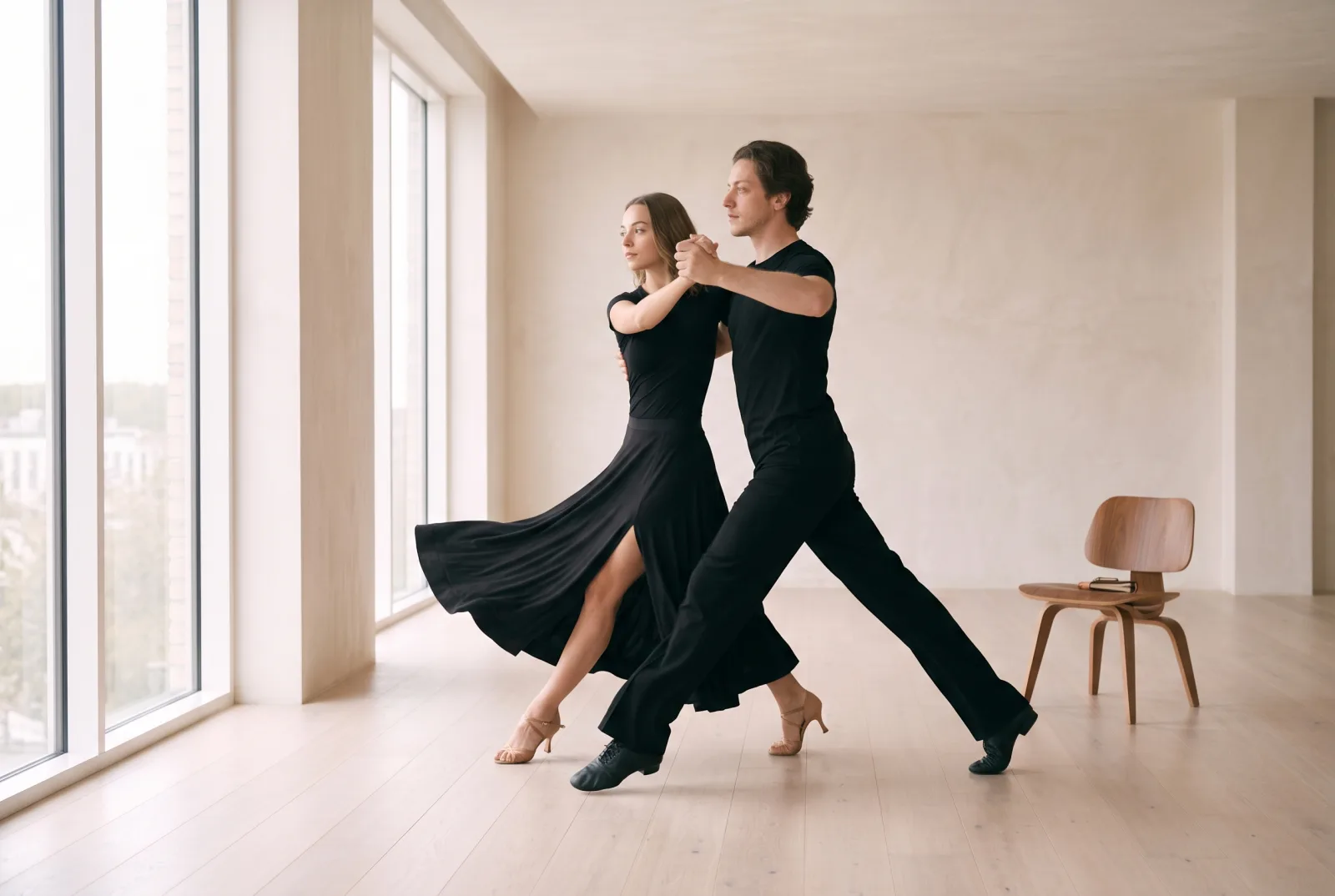
The foxtrot is the smoothest of the ballroom dances, a long, gliding travel across the floor that looks almost like elegant walking. There is no bounce to it and no drama; the pleasure is in the effortless flow, one continuous movement carrying the couple down the room. Danced to easy swing and jazz standards, it is the sound of an old ballroom at its most relaxed.
That smoothness is also what makes the foxtrot a little more demanding than it looks. The steps are simple, but keeping them seamless, with no visible effort between them, is a skill you build over time. Most people learn it after the waltz, because the posture, frame, and rise and fall carry straight over and the foxtrot then teaches you to make them travel.
- Family
- Ballroom (smooth / standard)
- Timing
- 4/4 time, slow-quick-quick
- Feel
- Smooth, gliding, continuous
- Origins
- United States, early 1900s
- Good first dance
- Great as a second dance
What makes a foxtrot a foxtrot
The foxtrot's signature is continuous, level travel. Where the waltz rises and falls in gentle waves, the foxtrot glides along a smoother line, using slow steps that cover a lot of ground and quick steps that tuck neatly between them. The classic rhythm is slow-quick-quick, and once it is in your body the dance almost carries itself.
The other half of the character is softness. Heels lead the smooth walks, the knees stay relaxed, and nothing is sharp or sudden. A good foxtrot looks like the couple is being carried across the floor rather than stepping across it.
What you'll learn first
You usually begin with the basic slow-quick-quick walks and the feather step, the figure where the leader steps outside the partner and the dance takes on its soft, curving shape. From there come the three step and the natural turn, which let the foxtrot travel and change direction while staying smooth.
Underneath the figures you are refining two things you may already know from the waltz: a calm frame and gentle rise and fall. In the foxtrot they are put to work travelling continuously, which is the real lesson of the dance.
Is the foxtrot good for beginners?
It is very learnable, and many studios teach it early, but it rewards a little groundwork first. If you have spent time on the waltz, the foxtrot will feel like a natural next step, because it borrows the same posture, frame, and rise and fall.
If it is your first dance, that is fine too, just expect the smoothness to take a bit of patience. The steps come quickly; making them look effortless is the part you keep polishing, and that is true even for experienced dancers.
How to practise the foxtrot at home
The foxtrot travels, so give yourself a clear line across a room to walk along. Practise the slow-quick-quick rhythm as simple walks first, leading with the heel on the slows, and keep your upper body quiet and tall while the feet do the work. A slow swing track at a relaxed tempo is ideal.
Filming yourself helps here, because the foxtrot lives or dies on smoothness and that is hard to feel from the inside. Inside YODS you can dance for the coach and get feedback on whether your travel really is continuous or whether it is stopping and starting between steps.
Learn the foxtrot with YODS
Video lessons that build the foxtrot step by step, plus a live AI coach that watches you dance and gives feedback in the moment. Start with a free account.
Common questions about the foxtrot
Is the foxtrot hard to learn?
The steps are simple, but the smooth, continuous style takes practice to master. It is very approachable to start, and it comes especially quickly if you have already learned the waltz, which shares its posture and frame.
What music is the foxtrot danced to?
Easy swing and jazz standards, the big-band ballroom sound, usually at a relaxed, medium tempo. If a song has a smooth, walking swing feel, it will suit the foxtrot.
Do I need a partner to learn the foxtrot?
No. You can learn the walks, timing, footwork, and rise and fall on your own. A partner helps later for the travelling figures and the frame, but it is not needed to begin.