
Learn to dance
Waltz
The rise, the fall, and the sweep of three-four time.
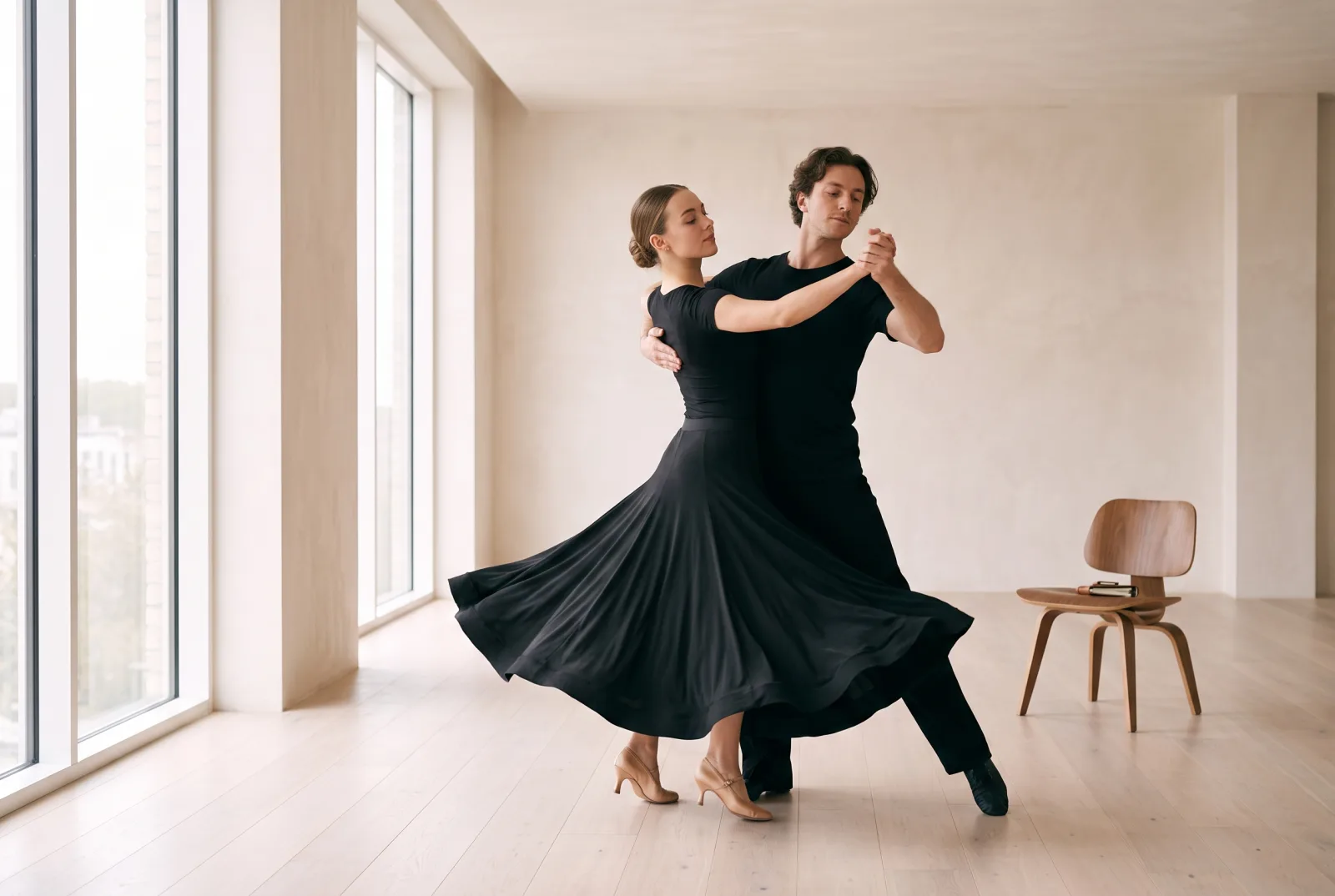
The waltz is the dance most people picture when they picture ballroom: two people gliding across a floor in long, smooth curves, rising and falling like a slow breath. It is danced in three-four time, so instead of the steady four-count pulse of most music you count in threes, one-two-three, one-two-three, with a gentle lift on every set.
That lift, the rise and fall, is the whole character of the dance. It is what turns walking into floating. The waltz is also one of the kindest dances to start with: the timing is forgiving, the shapes are simple before they are beautiful, and almost everything you learn in it carries over into the other smooth ballroom dances.
- Family
- Ballroom (smooth / standard)
- Timing
- 3/4 time, counted 1-2-3
- Feel
- Smooth, gliding, rise and fall
- Origins
- Central Europe, late 1700s
- Good first dance
- Yes, one of the best
What makes a waltz a waltz
Three things give the waltz its signature. First, the three-four timing: every measure has three beats, and the first is the strong one, which is why the dance feels like it swings gently from step to step. Second, rise and fall, the smooth rise onto the balls of the feet through the middle of a figure and the lowering at the end. Third, sway, the soft lean of the body that carries you around turns without losing balance.
Put together, these are why the waltz looks like gliding rather than stepping. Nothing is sharp or sudden. The couple moves as one shape, holding a steady frame, and the room seems to open up in front of them.
What you'll learn first
Most people start with the box step, a simple square pattern that teaches the three-count timing without any travelling. From there you add the natural turn and the reverse turn, which are the same idea curved so the couple rotates as they move down the floor.
Alongside the steps you build the two things that make them feel like a waltz: a calm, connected frame with your partner, and the rise and fall that lifts each set of three. Get those two habits early and every new figure you learn later will already look like real dancing.
Is the waltz good for beginners?
It is one of the best places to begin. The slow tempo gives you time to think, the box step is quick to grasp, and the smooth style is more forgiving of small mistakes than a fast, sharp dance would be. You can dance a recognisable waltz on your very first session.
It also builds the foundations, posture, frame, timing, and floor craft, that the foxtrot, Viennese waltz, and quickstep all borrow. Time spent on the waltz is never wasted.
How to practise the waltz at home
You need less room than you think. A space a few steps wide is enough for the box step, and you can practise rise and fall almost on the spot. Put on a slow waltz at around 84 to 90 beats per minute, count the one-two-three out loud until it stops feeling like counting, and use a mirror or your phone camera to check that your rise is smooth rather than bouncy.
This is also where a coach who can watch you helps most. Inside YODS you can dance in front of the camera and get feedback on your timing and frame in the moment, which is the part that is hardest to judge on your own.
Learn the waltz with YODS
Video lessons that build the waltz step by step, plus a live AI coach that watches you dance and gives feedback in the moment. Start with a free account.
Common questions about the waltz
Is the waltz hard to learn?
No, it is one of the easier ballroom dances to begin with. The tempo is slow, the basic box step is simple, and the smooth style forgives small timing slips. Most people dance a recognisable waltz on their first attempt.
What music is the waltz danced to?
Any music in three-four time at roughly 84 to 90 beats per minute. If you can count a steady one-two-three along with a song, you can waltz to it.
Do I need a partner to learn the waltz?
No. You can learn the steps, timing, rise and fall, and posture on your own, and many people do. A partner is useful later for practising the frame and leading or following, but it is not needed to start.
Dance terms
More dances