
Learn to dance
Quickstep
Fast, bright, and light on the feet, the happiest dance in the ballroom.
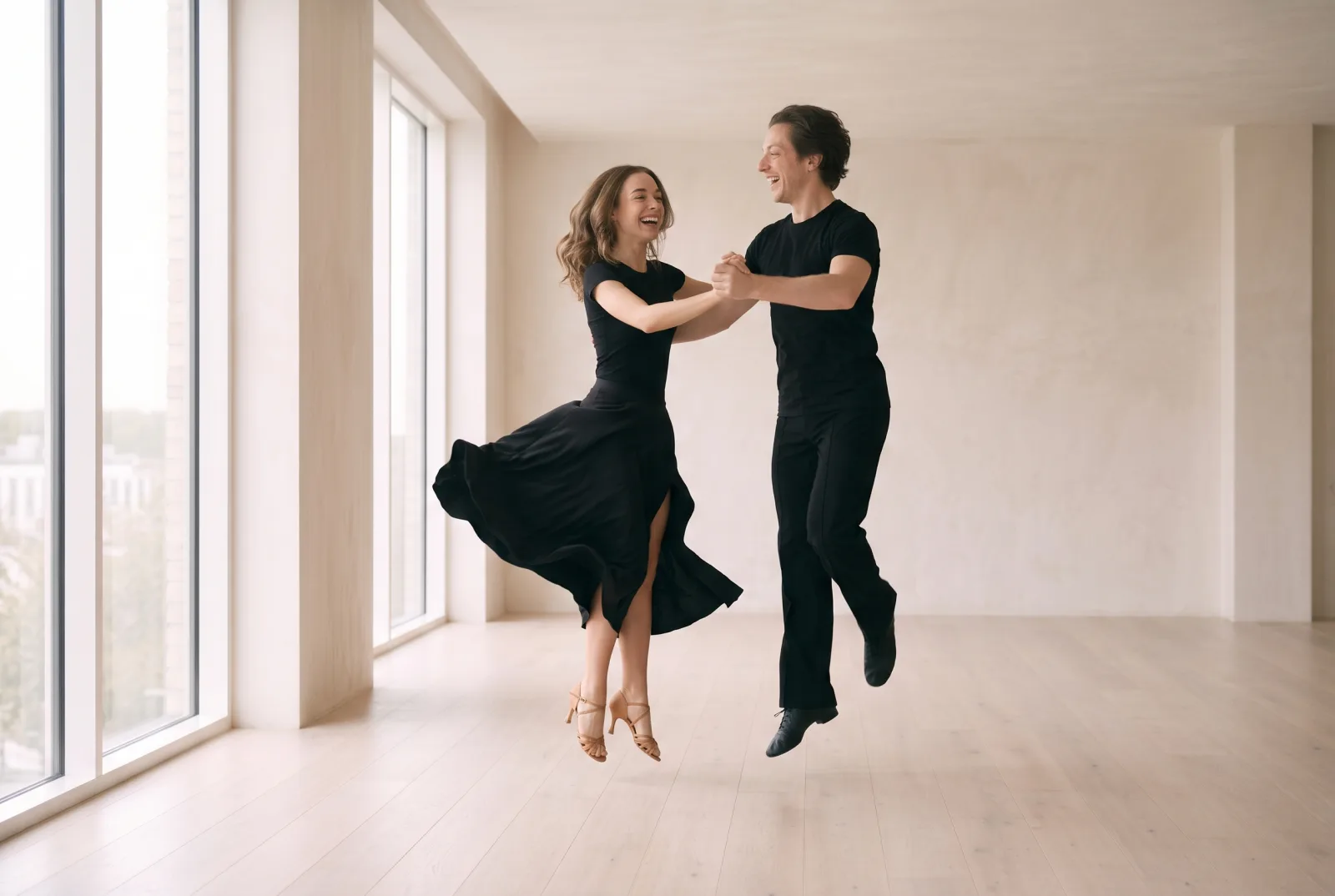
The quickstep is the ballroom's burst of joy: fast, light, and full of skips, runs, and little hops that skim across the floor. It grew out of a quicker version of the foxtrot in the 1920s and kept all the smoothness while adding speed and sparkle. Watching a good quickstep is like watching someone dance downhill, quick and bright and grinning.
For all that energy it is friendlier than it looks. The speed is real, but the basic figures are logical and repeat, and much of the dance is built from a few travelling steps chained together. It is usually learned after the slower smooth dances, so the posture and frame are already in place and you can put your attention on staying light and on time.
- Family
- Ballroom (smooth / standard)
- Timing
- 4/4 time, fast, slow and quick counts
- Feel
- Light, bright, bouncy, quick
- Origins
- 1920s, from the quick foxtrot
- Good first dance
- Better after a slower dance
What makes a quickstep a quickstep
Speed and lightness. The quickstep travels fast around the floor using chassés, lock steps, and little runs, staying up on the balls of the feet so the whole dance feels buoyant. There is a gentle bounce to it, controlled and springy rather than heavy, that gives it its bright, happy character.
Underneath the sparkle it is still a smooth dance: the couple holds a ballroom frame and travels in a continuous line around the room. The trick of the quickstep is keeping that smoothness while moving quickly and lightly, which is exactly what you spend your time learning.
What you'll learn first
The building blocks are the quarter turns, the chassé, and the lock step, the crossing travelling step that gives the quickstep its skimming look. Chained together these already produce a recognisable quickstep that travels down the floor.
The real skill you are developing is staying light and precisely on time at speed. That means good balance, a quiet upper body, and quick, neat footwork, habits that are easier to build if you have danced something slower first.
Is the quickstep good for beginners?
It is a wonderful dance, but it is usually not the first one to learn. The speed leaves less time to think, so most people come to it after the waltz or foxtrot, when posture, frame, and timing are already comfortable.
If you are drawn to it, do not let that stop you, just be ready to practise the basics slowly before bringing them up to tempo. Every good quickstep dancer learned it at half speed first.
How to practise the quickstep at home
Start slow, always. Practise the lock step and chassés at a gentle tempo until the footwork is neat and light, then gradually speed up. Stay up on the balls of your feet, keep your steps small and precise, and let the bounce come from soft knees rather than the upper body.
Because the quickstep is so quick, it is hard to tell from the inside whether you are staying light and on time. Filming yourself or dancing for the YODS coach gives you that outside view, which is where most of the fast improvement comes from.
Learn the quickstep with YODS
Video lessons that build the quickstep step by step, plus a live AI coach that watches you dance and gives feedback in the moment. Start with a free account.
Common questions about the quickstep
Is the quickstep hard to learn?
The speed makes it one of the more challenging ballroom dances, but the basic figures are logical and repeat. Learned slowly first and then brought up to tempo, it is very achievable, especially after a slower dance like the waltz.
What music is the quickstep danced to?
Upbeat swing and big-band music at a fast tempo, roughly 200 beats per minute. Bright, bouncy songs that make you want to skip are the natural fit.
Do I need a partner for the quickstep?
No. You can learn the footwork, timing, and lightness on your own, and practising the fast steps solo is a good way to build them. A partner is useful later for the travelling figures in frame.
Dance terms