
Learn to dance
Latin dances
Rhythm, hip action, and five dances with five personalities.
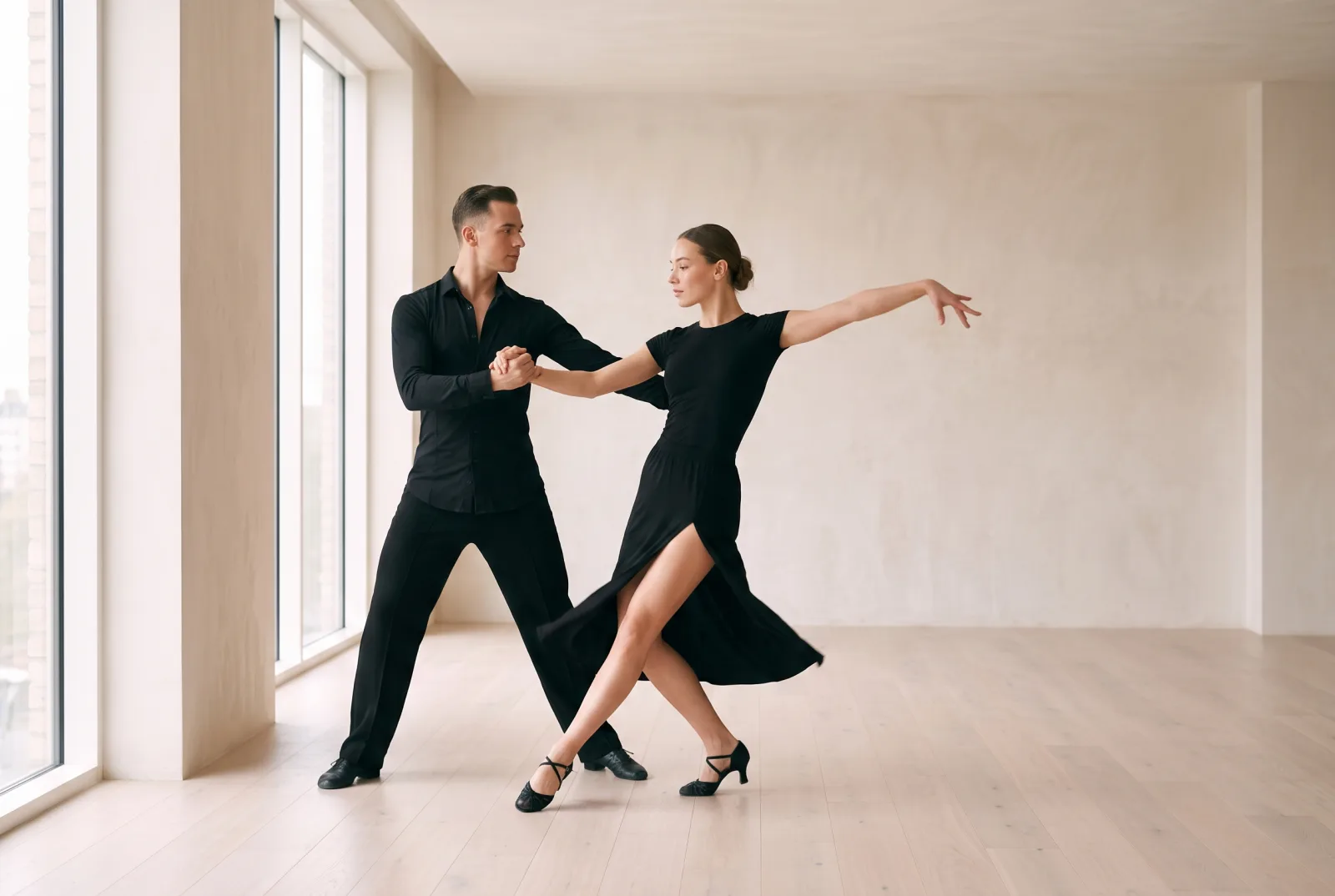
Latin dances comingThe Latin dances are the ballroom's rhythmic, expressive cousins. Instead of gliding smoothly around a room in a closed hold, they stay closer to one spot and put the beat and the body front and centre: sharp footwork, melting hip action, and plenty of room for spins and personality. They are often where people feel the music most quickly.
As a competition category, Latin gathers five dances that share this rhythmic spirit but each have a completely different mood, from the flirty cha cha to the dramatic paso doble. This guide is an overview of the family and how to find your way into it. You do not have to learn all five, most people fall for one or two and start there.
- Family
- Latin (the rhythm dances)
- The five dances
- Cha cha, rumba, samba, paso doble, jive
- Feel
- Rhythmic, expressive, hip-led
- Origins
- Latin America, Spain, and the USA
- Good first dance
- Cha cha or rumba
The five Latin dances
The Latin category brings together five dances that share a love of rhythm and expression but each carry their own personality.
The cha cha is the flirtatious one, quick and cheeky, built around the syncopated cha-cha-cha step. The rumba is its slow, romantic counterpart, often called the dance of love, all unhurried lines and melting hip action.
The samba carries the bounce and joy of Brazilian carnival. The paso doble is pure drama, a proud, marching dance modelled on the Spanish bullfight. And the jive is the wild card: fast, bouncy, and full of kicks and flicks, born from swing and rock and roll.
What makes Latin different from ballroom
Where the ballroom dances travel around the room in a closed hold, the Latin dances stay more in one place and put the rhythm first. The signature is the hip action, sometimes called Cuban motion, which comes from bending and straightening the knees as the weight moves, letting the hips settle naturally into each step rather than being pushed.
Latin also opens up the hold. Couples spend more time apart, joined by a hand, which makes room for spins, turns, and each dancer's own expression. It is a more playful, individual way to dance than the single shared shape of ballroom.
Is Latin good for beginners?
Very much so, and it is often where people feel the beat most quickly. The cha cha and rumba are the usual starting points: the cha cha because its rhythm is catchy and forgiving, and the rumba because its slow tempo gives you time to feel the hip action that runs through all the Latin dances.
The faster dances like samba and jive, and the dramatic paso doble, tend to come a little later, once the basic rhythm and hip action feel natural. But there is no wrong order, and many people simply start with whichever one they cannot stop tapping their foot to.
How to practise Latin at home
Latin needs less floor than ballroom because it travels less, so a small space is plenty. Start with the basic step of one dance, the cha cha or rumba is ideal, and practise the weight changes slowly until the hip action appears on its own rather than being forced. Put the music on and let the rhythm lead you.
Because so much of Latin is about how the movement looks and feels rather than covering ground, a camera is your best friend. Inside YODS you can dance for the coach and get feedback on your timing and hip action, which are the things hardest to judge from the inside.
Learn the latin dances with YODS
Video lessons that build the latin dances step by step, plus a live AI coach that watches you dance and gives feedback in the moment. Start with a free account.
Common questions about the latin dances
What are the five Latin dances?
In the competition Latin category they are the cha cha, rumba, samba, paso doble, and jive. They share a rhythmic, expressive style but each has its own tempo and character.
Which Latin dance is easiest to learn first?
Most people start with the cha cha or the rumba. The cha cha has a catchy, forgiving rhythm, and the rumba's slow tempo gives you time to feel the hip action that runs through all the Latin dances.
Do I need a partner to learn Latin dance?
No. You can learn the basic steps, timing, and hip action on your own, and the more open Latin hold actually makes solo practice easier. A partner helps later for turns and partnering, but it is not needed to begin.
Dance terms